

Martial Arts and Sports, which is better?
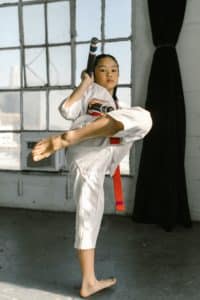
Anything sports can do, martial arts do better
I loved doing sports when I was kid—football, baseball, anything else I could manage. I support sports. But the underlying goal of sports programs is to win.
There are valuable lessons to learn in both winning and losing: how to persevere, how to be a gracious winner that expresses humility rather than arrogance. But these lessons focus on success, rather than development and progress. Losing a game means feeling horrible, and sometimes coaches contribute by their aggressive response to mistakes. We do need to learn how to deal with setbacks, but martial arts offers us a better way.
An article from the Journal of Applied Developmental Psychology measured a martial arts class against other physical education options in a school setting and found that the martial arts option showed greater development in self-regulation and social interactions. The study compared, over three months, more than 200 children in kindergarten through 5th grade. The martial arts group showed consistent and significant improvements in math, cognitive, and conduct tests over the standard PE group.
Why is this case? Sports are fun, and we’re told they have the intention of improving and developing character. But ask any martial arts instructor and you’ll hear a different answer: we go well beyond the focus on winning and losing to work on developing all areas of an individual.
· Setting goals for individual improvement
· Sharing encouragement within a safe space
· Helping others and increasing respect
· Working together to improve
· Learning how rules and boundaries promote growth
· Practicing and improving through repetition
· Developing mental focus and skills across learning modalities
· Growing mental resilience and perseverance
We also develop a much wider range of physical skills than students need for a specific sport. A sport might develop physical strength or resilience or teach a student how to kick or run correctly. But martial arts develops all these skills, as well as asymmetrical learning, agility, balance, and coordination.
This holistic approach makes martial arts an ideal activity for you and your child. While sports do offer some of these benefits, their outcomes pale in comparison with the growth and learning achieved through martial arts training.
Article citation: Promoting self-regulation through school-based martial arts training, Kimberley D. Lakes, William T. Hoyt, published 1 May 2004. Journal of Applied Developmental Psychology. Available: https://www.sciencedirect.com/science/article/abs/pii/S0193397304000309?via%3Dihub